

Dispatches from Detention shares stories of people encountered by Kennedy Human Rights Center in legal outreach trips to the country’s most isolated immigration detention centers. Names have been changed to protect privacy.
Buffalo Federal Detention Facility, Batavia, New York
“Five ICE vehicles surrounded me, and my granddaughter and her classmates watched from the window of the bus. That was four months ago.”
– David, Afganistan
For more than thirty years, David did exactly what the United States government asked of him. He lived in the United States under an Order of Supervision because his country of origin would not accept his return by deportation, one of the many forgotten legal limbos in the U.S. immigration system. He reported when told to report. He worked steadily, paid taxes, raised children who grew into adults, and watched them build families of their own. He became, in every way that matters, a grandfather in America.
He never missed a check-in.
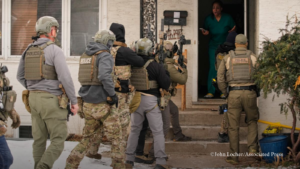
And yet, on a September morning in 2025, Immigration and Customs Enforcement (ICE) agents came for him—not in a courtroom or at an office check-in, but at a school bus stop. Five ICE cars and 7 agents waited for him as he dropped his granddaughter off at the curb.
Not because anything had changed about his case. Not because he had violated the terms of his supervision. Not because he posed a danger to anyone. But because the system rarely has to answer for when it does. That was four months ago. Today, in January 2026, David is detained at the Buffalo Federal Detention Center, in Batavia, New York.
What does thirty years of compliance buy you in the United States? Apparently, not trust. Not dignity. Not even a phone call saying: Things have changed, prepare yourself. Instead, it buys you handcuffs at a school bus stop with the eyes of children and families fixed upon you.
Orders of supervision are sold as a kind of mercy—You can stay, for now, if you behave. They can last for years when removal is often not actually possible, as in cases of people from “recalcitrant countries” that refuse or delay accepting deportees. Over time, people put down roots: they build families, hold steady jobs, and comply faithfully with the rigid conditions imposed by their supervision. What ICE does not say is that this same “mercy” operates as a leash that can be yanked at any moment, without warning, without explanation, without regard for the lives built in the meantime. They allow the government to say, We let you stay, while retaining the power to say, We can still take you. As administrative priorities have shifted, these orders have increasingly become tools of surveillance, weaponizing compliance and transforming routine check-ins into pathways for mass detention and heightened fear.
The government calls this enforcement, but revocation of an order of supervision is, in practice, a punishment—and to more than just the person locked inside a detention center. David’s granddaughter now asks why he isn’t there, a reminder that detention does not stop at bars and walls. It permeates daily life, touching every child waiting at a bus stop, every spouse staring at a silent phone, and every family doing all they can to afford one more legal bill.
This story is the predictable outcome of a system of dehumanization in which a person can comply for thirty years but then be taken in front of his granddaughter like none of it mattered. A system like this does not need more cages; it needs more exits. It needs real access to counsel, real review of who is being held and why, and a default assumption that liberty is the rule, not the exception, especially for people who have spent decades doing everything asked of them.
Related Content
Dispatches from Detention: Detained at a School Bus Stop

This Week’s Spotlight on Human Rights