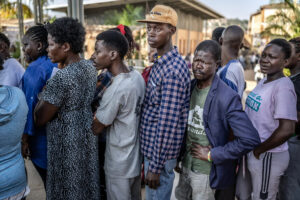


WASHINGTON, D.C., Jan. 15, 2025 –The Robert and Ethel Kennedy Human Rights Center (Kennedy Human Rights Center) and the Centre for Law and Democracy (CLD) announced today the public launch of a new report titled Freedom of Peaceful Assembly: Litigation Gaps and Opportunities at the International and Regional Levels. The report provides an in-depth assessment of the standards relating to freedom of peaceful assembly developed through the jurisprudence of international and regional human rights mechanisms, as well as strategic litigation opportunities to strengthen the framework for protecting the right to freedom of assembly worldwide.
Despite existing and fairly developed catalogues of key standards, such as those set out by the UN Human Rights Committee in General Comment No. 37 (Right of Peaceful Assembly), the number of cases concerning freedom of assembly before international, regional, and subregional human rights mechanisms has been limited. Meaningful engagement with substantive freedom of assembly issues occurs only in 49 cases across the human rights mechanisms covered, namely mechanisms at the UN level (the UN Human Rights Committee), in Africa (the African Commission and Court on Human and Peoples’ Rights, the Economic Community of West African States Court of Justice and the East African Court of Justice) and in the Americas (the Inter-American Commission on Human Rights and the Inter-American Court of Human Rights).
Even these low figures hide how sparse the jurisprudence of these mechanisms is in establishing freedom of assembly standards. Most of the cases involve claims of breaches of other human rights, leading to freedom of assembly claims being treated rather briefly.
To help address this issue, the Kennedy Human Rights Center and CLD developed this report to map out key gap-filling needs for the protection of freedom of assembly. These include:
- Further elaboration of the scope of the right (e.g., the right not to participate, when an assembly is no longer peaceful and hence no longer protected, and the types of illegal behavior short of violence or property destruction which are not allowed).
- Clarity on the positive obligation of States (e.g., putting in place an enabling legal framework, facilitating and providing security for assemblies, tolerating disruption, and raising awareness about freedom of assembly).
- Clarity on the restrictions that can be placed on assemblies (specifically concerning notification regimes, time, manner, and place restrictions, and the use of force).
- Elaboration of a clear framework of accountability and redress (e.g., obligation to investigate serious breaches).
Given this long list of gaps and the significant number of jurisdictions involved, strategic choices must be made by those seeking to engage in litigation in this area. The report canvasses some key considerations that need to be taken into account when developing a litigation strategy in the context of freedom of assembly, such as:
- Whether the main aim is to develop standards on this right generally or to develop them in a particular jurisdiction.
- The fact that some issues are harder to get at through litigation, as the more frequently occurring fact patterns are less likely to raise such issues.
- The fact that, in some cases, where the use of force has been excessive and individuals have been hurt, it may be difficult to get mechanisms to focus on the freedom of assembly violation rather than the other violations that arise in those cases.
This resource will serve as a practical tool that empowers global actors litigating and researching freedom of assembly to continue working toward stronger protections of this fundamental right.
As part of the launch of this report, the Kennedy Humans Rights Center and CLD will host a webinar on January 22nd, 2026, at 9 am ET, to facilitate dialogue among legal practitioners and international experts on the report’s findings and the future of strategic litigation on freedom of assembly. The panelists will include Gina Romero, the UN Special Rapporteur on the Freedom of Peaceful Assembly and of Association; Pedro Vaca, the IACHR Special Rapporteur for Freedom of Expression; Donald Deya, the Chief Executive Officer of the Pan-African Lawyers Union (PALU); and Toby Mendel, Executive Director of CLD. You can register for this event here.
###
About the Robert & Ethel Kennedy Human Rights Center:
The Robert & Ethel Kennedy Human Rights Center is a nonpartisan, not-for-profit organization that has worked to realize Robert F. Kennedy’s dream of a more just and peaceful world since 1968. In partnership with local activists, we advocate for key human rights issues—championing change makers and pursuing strategic litigation at home and around the world. And to ensure change that lasts, we foster a social-good approach to business and investment and educate millions of students about human rights and social justice. Learn more at rfkhumanrights.org.
About the Centre for Law and Democracy:
The Centre for Law and Democracy (CLD) is an international human rights organization based in Canada and providing expert legal services globally. We work to promote, protect, and develop those human rights which serve as the foundation for or underpin democracy, including the rights to freedom of expression, to vote and participate in governance, to access information, and to freedom of assembly and association. Learn more at https://www.law-democracy.org/.
Related Content
This Week’s Spotlight on Human Rights
Uganda: Authorities Must Desist from Attacks on Civic Space and Investigate 2026 Electoral Period Violations